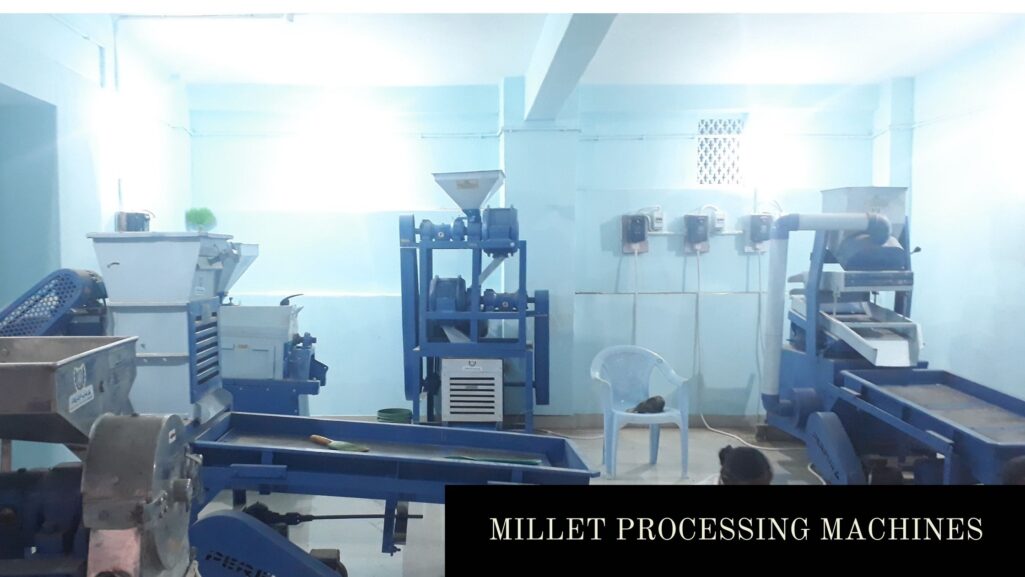
Millet Processing Machine:
When it comes to millet processing it is a tedious job. As you know the demand for millets is increasing day by day in India and abroad. People are becoming health conscious and searching for the best quality millet grains. It is possible only with the advancement and up gradation in the millet processing machine.
Now, let’s understand the millet grains. As you know there are 9 types of millets grown in India. It is categorized into two, one is naked and the other is husked millets. Sorghum(Jowar), Pearl Millet(Bajra), and Finger Millet(Ragi) come under naked grains, and the rest millets like Foxtail Millet, Little Millet, Barnyard Millet, Kodo Millet, Browntop Millet, and Proso Millet comes under husked grains as it contains a husk layer on it.
Why Processing is required?
Processing of husked millets is essential to make it suitable for human consumption. It starts with cleaning, grading, and removing husks. As you know husks cannot be digested by human beings. To understand the processing of millets I went to a tribal village in Koraput, Odisha. I could find a single wooden grinding mill in this village and all the people depend upon this mill to process their millets.

Nowadays, we don’t process much as processing is tedious and takes a long time. We only consume finger millet(Ragi) as it is easy to clean and ground into flour and also easy to cook said tribal women of Bhejapadar village.
Really it involves a lot of drudgeries. If you see the process starting from cleaning, separating the stones and inert materials from the grains, and finally putting it into the grinding mill. I documented the entire processing so that we can understand it in a better way.
Methods of Processing Millets:
As the husk is firmly attached to the grains so, it requires force to remove it. In this millet processing, two forces are applied one is shear force and the other is impact force. As you saw in the above video, the shear force is applied in this process whereas in the below photograph, the impact force.

Manual hand pounding is a hard job to do. We don’t have other options. On special occasions, we do the processing of millets. But the food is tastier as compared to the millets available in the market said by tribal women.
The millet processing machine works with centrifugal force. The husked grains hit the cast iron and the outer covering breaks. We can say it uses the impact force.
Hope you understood the basic of millet processing in the rural areas. Now, it’s time to go through the machines required for millet processing. We will discuss setting up a millet processing unit, its layout, and design.
Millet Processing Machinery required for setting up a small scale Unit:
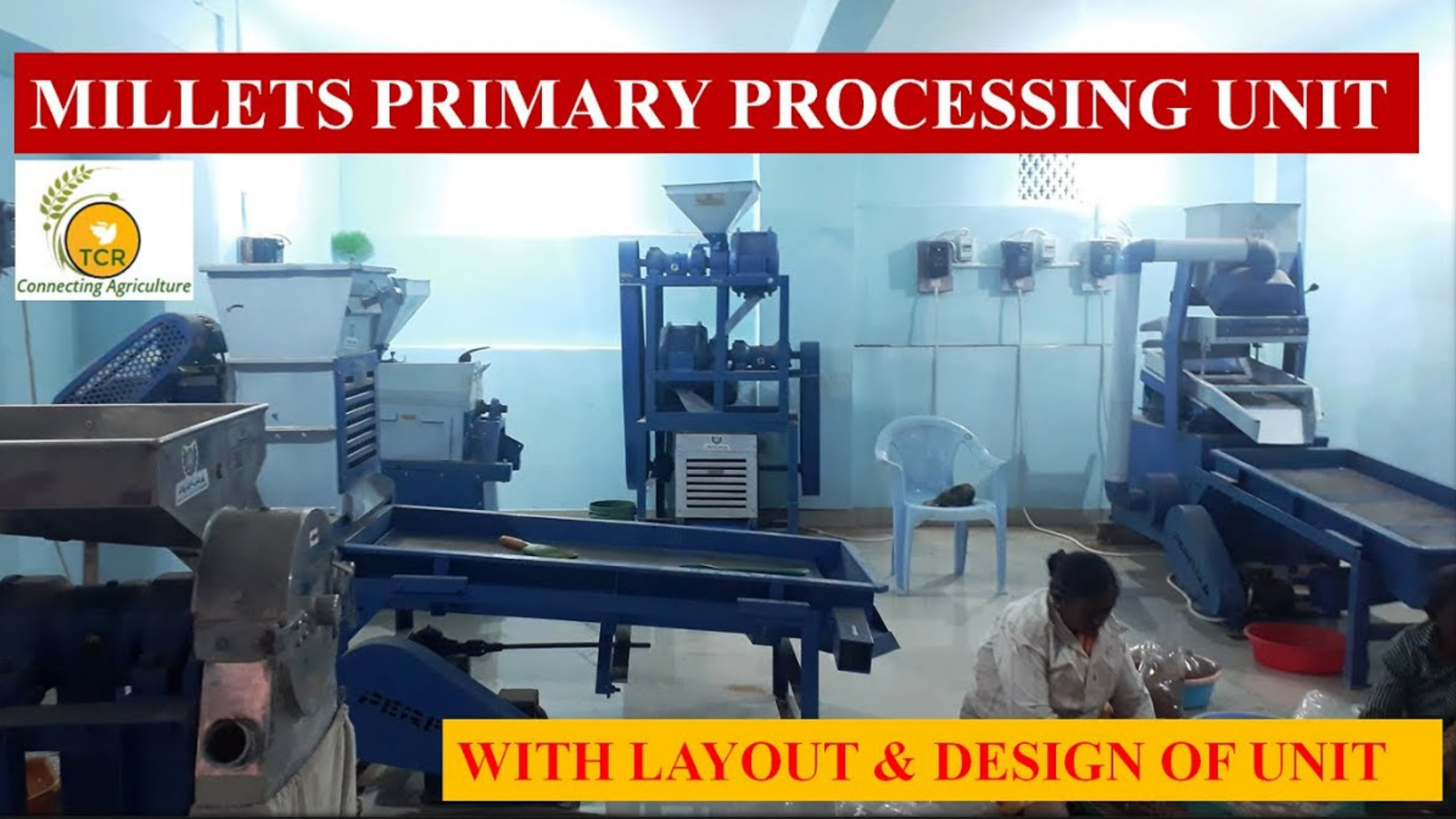
To understand millet processing, I had an opportunity to visit the Primary Processing Unit at the Indian Institute of Millets Research, Hyderabad. Basically, to set up a unit we require machines for cleaning, grading, dehulling, and finally the quality product. Let us know about these machines.
Grader-cum-Aspirator:
The grader is used for separating the inert materials like big stones, sticks, sand, grass, etc. from the grains. These are separated by sieves of different sizes. Care should be taken to select the right sieve size and the operator should see that the holes of the sieve are not clogged.
Generally, a triple deck grader with three sieves is used. The top sieve helps in separating the big sticks, stones, and grasses, the middle one separates the good quality grains, and the bottom separates the fine and coarse sand particles.
The aspirator has a small fan that sends the dust and light particles to the rear end.
Destoner-cum-Aspirator:
The grains coming from the grader are put into destoner for removing the small stones and mud balls which are identical to the size of the grains. Destoner works based upon gravitational principles. There are two sieves in this machine. The millet grains after falling on the destoner bed, the lighter material moves to the front and the heavy materials towards the back. The air adjustment slot is to be adjusted as per requirement.
It is better to have a Variable Frequency Drive, which lessens the mechanical and electrical stress on the machine. This reduces the wear and tear of the machine.
Dehuller-cum-Aspirator:
After proper cleaning and grading, the millet grains are put into dehuller for husk removal. There are two types of dehuller, one is the Centrifugal and the other is the Abrasive dehuller.
Centrifugal Dehuller :
It has an impeller that is responsible for the removal of husk from the millet grains. When the grains are put into the hopper, it enters the impeller, where it is thrown with a great centrifugal force onto the hard casing of the impeller. Due to heavy impact force, the husk gets separated. The lighter husk is collected at the back and the dehulled grains are collected at the front.
The efficiency of the machine is measured based on the hulling recovery and the retention of bran on the grains.
Abrasive Dehuller:
They are classified into two types, one is the Emery abrasive, and the other is the rubber roller type. In Emery type, two grinding stones are used. One stone is stationary and the other rotates at a constant speed.
Manufacturers of Millet Processing Machine:
- Perfura Technologies (India) Pvt. Ltd
- AVM Engineering Industries
- Victor Agro Sales
- Agromech Engineers
- KMS Industries
- Borne Technologies Private Ltd
In addition to these, there are organizations that have developed a millet processing machine. DHAN Foundation has developed India’s First Table Top Dehuller.
DHAN Foundation implemented ‘Scaling up Small Millet Post Harvest and Nutritious Food Products Project in collaboration with Tamil Nadu Agriculture University and McGill University, Canada.
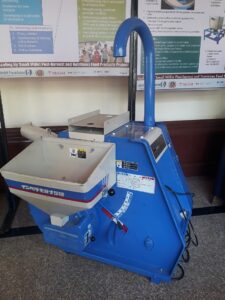
Millet Processing Machine Requirements and Infrastructure at a different level:
- Village/Community Level: We require a space of 200 square feet floor area. Destoner-cum-Grader with Aspirator and a Dehuller is sufficient. It may cost around 2 lakhs. Tabletop dehuller will fit into this project. Its capacity is around 50kg/hr and two-person can easily operate it. It can work in a single phase.
- Small Scale Level: It requires a minimum of 1200 square feet floor area to operate the machines. Destoner, Grader, and Dehuller 2 number each is required. Its capacity is around 100 kg/hour. It may cost around 4-5 lakhs.
- Medium Scale Level: The capacity of this enterprise may be around 500-1000 kg/hour. 5000 to 10,000 square feet is required with godowns to stock raw materials up to 10-20 tonnes. In this enterprise, we can keep Destoner and Grader of 4 to 8 Nos, Dehuller 2 to 4 machines. For value addition, we can keep Pulveriser, Semolina Machine, Flakes Making Machine. It cost maybe around 20-30 lakhs.
- Large Scale Level: Most of the large scale Enterprises are found in Nashik. It may cost around 60-70 lakhs.
Points to be considered before purchasing Millet Processing Machine:
- Do a survey and research of the market potential before taking up the project.
- Visit some successful enterprises and study the difficulties faced in the initial stage.
- Buy the machines only after checking the performance.
- New Entrepreneurs should take training before starting the project.
- A better understanding of the sieve size and the size of the millet grains.
Author: Tapas Chandra Roy, A Certified Farm Advisor on Millets