Category: Finger Millet

  • Utilisation of Finger Millet in Nutritional Security

    Utilisation of Finger Millet in Nutritional Security

    To utilize Finger Millet for Nutritional Security we have to focus on the following points in the coming days:
    Utilisation of Finger Millet in Nutritional Security
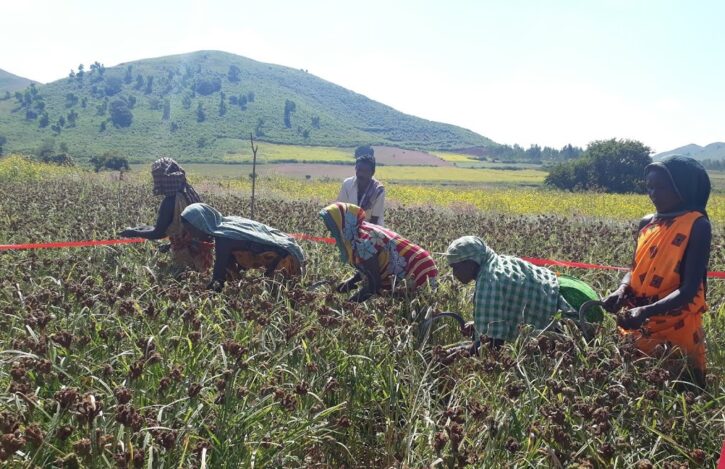
    Crop Cutting of Finger Millet

    1. To increase the production and productivity of Finger Millet:

    • Awareness creation on the system of millet intensification(SMI) of finger millet as this the method is giving more yield as compared to traditional methods.
    • Conservation of local promising varieties which are giving more yields and sustaining from climate change.
    • Giving more priority for weed control as it is the main constraints in Finger Millet production.
    • Sowing/transplanting in time will enhance the production and productivity of finger millet.
    • More production of finger millet will bring change in the livelihood of the tribal’s by addressing the consumption part and also by selling in the market/mandi.
    • Farmers must be encouraged to use the finger millet residue as fodder as it contains more nutrients and fiber.
    • Development of context-specific improved varieties to improve productivity, increase shelf-life, improved nutritional content, and promote crop diversity.

    2. To address the consumption of finger millet:

    Utilisation of Finger Millet in Nutritional Security
    A farmer showing his Ragi Porridge(Mandia Jau in Odia)
     
    • Consumption of finger millet, every day is a tradition of tribal’s as they keep 75% of their finger millet produces for consumption. It is seen that, the availability of finger millet in their house is almost for 12 months (65% households) but we have to address the rest (35% households) for round the year availability.
    • The perception of most households is that they consumed finger millet as it gives more energy than other food and they can easily do the daily routine work and least were unaware of the control of blood sugar.
    • Odisha tribals possess traditional knowledge of making different types of recipes from finger millets for ages. But we have to encourage them by organizing a food festival.
    • As no modern recipe was available in the market neither they had any idea to make it. Only giving them training time to time will help to build their skill in cooking and simultaneously we can encourage the local entrepreneurs to come out with modern recipes at their local market. It is seen that most of them have the interest to have modern recipes like cakes, biscuits, and ladoos.
    Utilisation of Finger Millet in Nutritional Security
    Suggestions to increase the consumption of Finger Millet
    • All recommended to include ragi in mid-day meals and ICDS. The second suggestion (42 sample household) was to include ragi in PDS followed by awareness creation among farmers about health benefits, organizing food mela, an outlet of millet products in the local market, and finally training to farmers. They all had a concern that their children do not take ragi and including in mid-day meals and ICDS will surely address the nutritional security and malnutrition.
    •  

    3. To address the primary and secondary processing of Finger Millet:

    Utilisation of Finger Millet in Nutritional Security
    Understanding Traditional Millet Processing
    • 67% of households come under marginal and small farmers and 56% did not have any assets like farm implements, pump sets, motorcycles, and tractors. 86% do their threshing of finger millet manually by using sticks. This can be addressed by establishing community hiring centers and also encouraging entrepreneurs to establish an agriculture service center in the locality.
    • Most of the sample household (69 percent) do their milling by using traditional chhaki and rest (30 percent) by pulverizer. It was found that the sample households near to market availed the service of pulverizer. Community pulverizers can address this issue and can simultaneously reduce the drudgery of women.

    4. Initiatives are taken under Odisha Millet Mission:

    System of Millet Intensification in Farmer’s Field
    • Around 50,000 farmers have been mobilized to take up millet cultivation with improved agronomic practices. Incentives to farmers for millet cultivation. For SMI its Rs.5000/- per hectare in the first year and in the second year it’s Rs.3000/- per hectare. Similarly, for line sowing/line transplanting its Rs.2500/- per hectare and Rs.1500/- per hectare in the first and second years respectively.
    • The State Government has already started the procurement of surplus ragi from the farmers. Last year(2018) around 18,000 quintals of Ragi were procured from farmers @Rs.28.97/kg and in the year(2019) the procurement target was enhanced to one lakh quintal @Rs.31.50/kg and procurement of about 95,000 quintals was done. In this year 2020, the MSP of Ragi is bringing more hope for Small and marginal farmers. 
    • Introduced supply of 1kg ragi under PDS in addition to 5 kg basket per person entitlement.
    • Plans are afoot for the inclusion of millets in supplementary nutrition programs under mid-day meals and ICDS.
    • Started public awareness about health, nutritional, environmental & other important benefits of consuming & cultivating millets. Plan to set up decentralized millet processing units in the block and gram panchayat level.
    • Plan to form a Farmer Producer Organisation in the block level as this will be an extension arm of government in the future for delivery of services.
  • Finger Millet Production- Important Factors and Constraints

    Finger Millet Production- Important Factors and Constraints

    FINGER MILLET PRODUCTION FACTORS AND CONSTRAINTS:
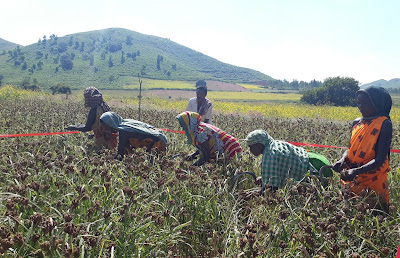
    Finger Millet Cultivation
    SMI of Finger Millet Crop Cutting Experiment

    Finger Millet(Eleusine coracana) commonly known as Ragi. It is grown for grains and fodder purposes under varied agro-climate conditions in India. It is cultivated on a variety of soils from rich loam to poor shallow upland soils.

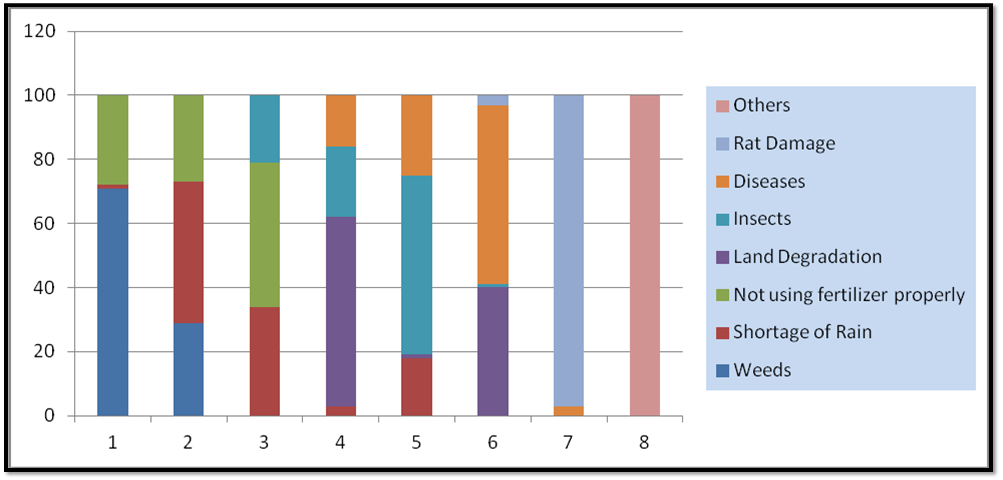
    To understand the constraints in Finger Millet Cultivation a study was conducted in Dasamantpur Block of Koraput District, Odisha. The important production-related constraints of finger millet in terms of spread across the sample villages and the number of affected farmers identified by the survey : 

    Important Production related Constraints:

    • Weeds
    • Shortage of rainfall
    • Land degradation
    • Insects
    • Diseases
    • Not using fertilizer properly
    • Rat damage
    • If any other

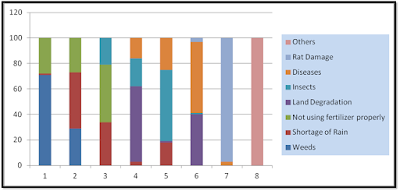
    Further to understand with reference to finger millets, the ranking of the constraints were done.
    Finger Millet Cultivation
    Figure: Ranking of the constraints in the production of finger millet

    After the study, it was found that weeds are the major problem in Ragi cultivation and it was ranked in the first position in terms of a problem followed by a shortage of rainfall, No using fertilizers properly, Land Degradation due to soil erosion, Insects, Diseases and Rat Damage.

    Recommendation:

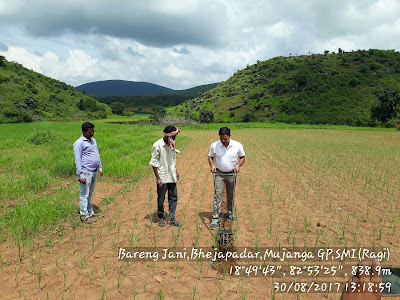
    Two weddings are recommended in finger millet. In line-sown or transplanting, weeding can be done with a tyne-harrow or push type operated wheel weeder or with a cycle weeder when the crop is 30 days old and next on the 45th day. In broadcast crop 1st weeding after 15-20 days and 2nd weeding on 35-40 days.
    Finger Millet Cultivation
    Checking the Push-type operated Wheel Weeder in Farmer’s Field

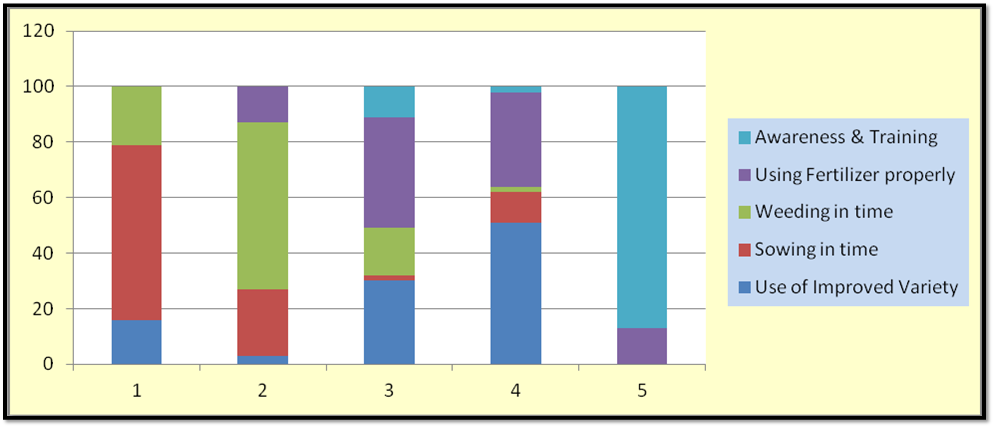
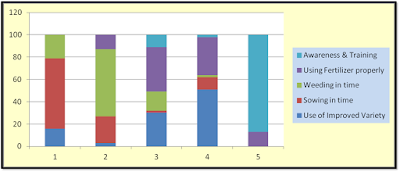
    Factor to increase the production of finger millet in the future: (100 respondents)

    Out of the 100 households who have reported on different factors to increase the ragi production, 63 percent of them indicated sowing in time is the first factor to increase production. The second factor is weeding on time (60 percent), third is the use of fertilizer properly (40 percent), fourth is the use of improved variety (51 percent) and fifth is awareness and training (87 percent).
    Finger Millet Cultivation
    Figure:  Ranking of factors to increase the production of finger millet

    From the study, it is understood that sowing in time is an important factor. Most of the farmers broadcast their seeds on the onset of the monsoon but those who opt for transplanting differ due to delay or shortage of rainfall. It is also found that old seedlings more than 25 days affect the yield. It is better to complete the sowing and transplanting in the month of July.

    Author: Tapas Chandra Roy, A Certified Farm Advisor on Millets. Promoting Millets from Farm to Plate.