Category: Millets

  • How Millet Food Festival ensuring Nutritional Security of Tribals in Odisha

    How Millet Food Festival ensuring Nutritional Security of Tribals in Odisha

    Millet Food Festival Ensuring Nutritional Security:

    Nutritional Security is achieved ”when all people at all times consume food of sufficient quantity and quality in terms of variety, diversity, nutrient content and safety to meet their dietary needs and food preferences for an active and healthy life, coupled with a sanitary environment, adequate health, education and care” (FAO, 2012). No doubt, now India is self-sufficient in food grain production but we are facing the challenges of nutritional security.

    So, India is taking a lot of initiative for achieving Nutritional Security by 2030. In Odisha, it is clearly mentioned in Samrudhi (Agriculture Policy-2020) in which the Vision aimed at continuously raising farmers’ income and welfare while ensuring nutritional security. Nutrition has become the mainstream of all agriculture activities. Odisha Millet Mission Model is one of the programs ensuring nutritional security.

    Food Festival under Odisha Millet Mission:

    Special Programme for Promotion of Millets in Tribals Areas of Odisha (Odisha Millet Mission) was launched by the Government of Odisha in 2017 to revive millets in farms and on plates. Under this mission, Millet Food Festival is a program of 2 days. On the first day, the tribal women are trained in making millet recipes, and on the 2nd day, they come with their own millet recipes. This program helps in bringing the forgotten millet recipes and also it gives learning for other women.

    Related Post: Traditional Millet Recipes of Koraput and their Perceptions

    Millet Food Festival in Koraput:

    Millets are part of everyone’s diet in the tribal areas of Koraput. We cannot live without millets as it gives us more energy to do all the activities throughout the day. Every morning starts with Mandia Jau (Ragi Porridge) said by Jema Majhi of PaikaPuki village of Gadiaguda Gram Panchayat in Dasamantpur Block.

    Millet Food Festivals were organized by DHAN Foundation in Dasamantpur Block. The tribal women were trained on the importance of millets and their nutritional value. They were taught how to make murukkus, ragi pakodas, ragi ladoos, and many more. The children of the village liked the millet recipes which were made on the first day.

    In 2019, when I was doing my Project Work on “Utilization of Finger Millet in Nutritional Security” could find out that including millets in the mid-day meals and in ICDS will increase the consumption of millets among the children. Many farmers’ concern was that their children hesitate to take millet food at home and they recommended including it in mid-day meals. Many children said that they don’t like ”Mandia Jau” every day but like to have ragi ladoos, ragi biscuits, cake, idli, dosa, millet upma, etc.

    On this day, the tribal women came with many recipes made out of Finger Millet, Little Millet, and Foxtail Millet. Finger Millet is the main crop of most farmers in Koraput as it is easy in cultivating, processing and make food items. But it is not the same case with Little Millet and Foxtail Millet as these millets require processing and it is very difficult to do.

    I was very happy to see the millet recipes. Really they have the talent in making awesome recipes. Now, let us see some recipes made by them on the Millet Food Festival Day.
    Millet Food Festival in Odisha
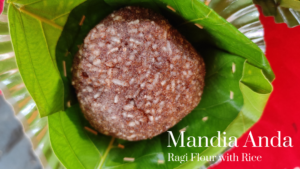
    Mandia Anda (Ragi Balls with Rice)
    Millet Food Festival in Odisha
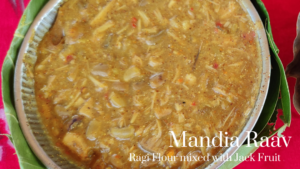
    Mandia Ponosh Raav( Ragi Flour mixed with Jack Fruit)

    The combination of Mandia Anda with Mandia Ponosh Raav is enjoyed by the children. As you know Jack fruit is known as the poor man’s fruit rich in vitamins A, B, C, and Calcium, potassium, proteins, iron, and carbohydrates. When millets mixed with fruits and vegetables it enhances the nutrition profile of the food.
    Millet Food Festival Odisha
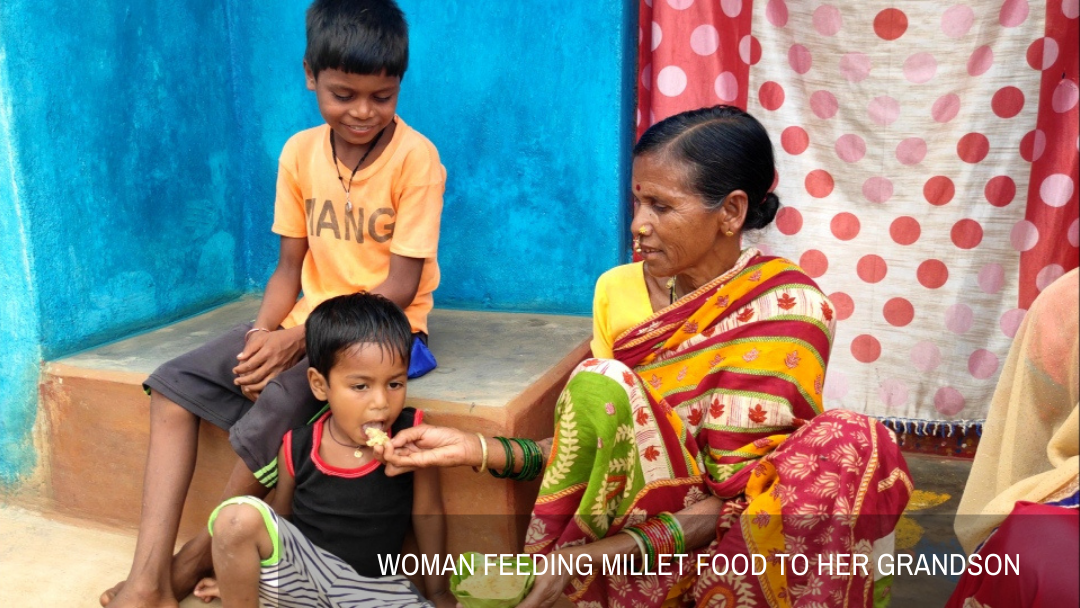
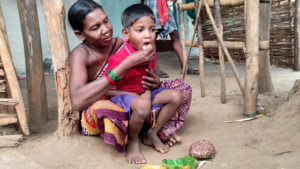
    Women feeding Millet food to her grandson

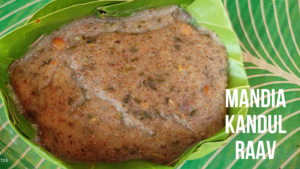
    Scientists have found out that a combination of Millets with Pulses increases the quality of protein. The proportion of essential amino acids in millets and pulses complement each other. One such recipe was with millets and arhar dal. In this recipe, water is taken in a kadai and heated up and then the greens and soaked arhar dal are put into it. Turmeric, chili, and salt are added. When it is cooked properly, ragi flour and tamarind are put into it. It is cooked for some time and the recipe is ready. The uniqueness I marked in most of the recipes is that they don’t use oil and spicy masala.
    Millet Food Festival in Odisha
    Mandia Kandul Raav (Ragi flour is mixed with Arhar Dal)

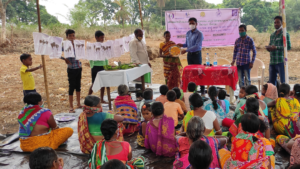
    In the beginning, they were a little shy to come out with the millet recipes but later on when they were encouraged and motivated. They were told that the best millet recipes will be awarded a prize. Few of them were excited to participate in this program. Looking into the uniqueness of the recipes, the first, second, and third were chosen and awarded. I could mark their happiness when distributing the prizes to the winners.
    Millet Food Festival in Odisha
    Distribution of Prize to the Winner

    Such Food Festival will encourage the women to make the forgotten millet recipes and it will be learning for other women when they exchange their ideas on how to make the millet recipes. In this way, we can revive the millets on plates and thus ensure Nutritional Security in the tribal areas of Odisha.


    Author: Tapas Chandra Roy, Certified Farm Advisor-Millets
  • Can we eat Millets daily in 2021 for better Health and Immunity

    Can we eat Millets daily in 2021 for better Health and Immunity

    Can we eat Millets Daily?

    The demand for Millets is growing as people around the globe have become more conscious about their health. Most of the health problems arise only due to the food we intake. The magnificent ancient grains taking their place in the diet plan due to their high nutrition profile. But while planning to include it in the diet, the spontaneous above question arises- “Can we eat Millets Daily”? Don’t worry, today I will be answering all the queries, and by the end will ensure that every stone of doubt is overturned.

    Benefits of eating Millets Daily:

    Millets were part of our diet as history speaks that Millets were cultivated around 7000 years back. In India during the 1960s Millets were the staple food grains but gradually after Green Revolution, it was replaced by Wheat and Rice. But now the trend of local grain has come back. Let us understand the benefits of eating Millets daily. Embracing the goodness of millets will definitely improve our health and immunity. In 2021, we should focus more on food rich in nutrients, minerals, vitamins, proteins, and anti-oxidants. I will say Millets are the right grains.

    • Millets are rich in Nutrition:

    Good nutrition is essential for our body to function well and to maintain good health. Millets are a good source of Calcium, Magnesium, Manganese, Phosphorous, Copper, Iron, and many more. Take the case of Ragi, it contains about 364mg/100 g of grains. Calcium is essential for strong bones. Pearl Millet is rich in Iron and Zinc and it is recommended for pregnant women.

    Can we eat millets daily
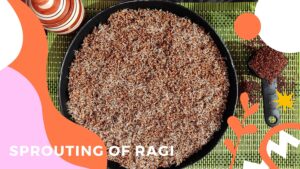
    Sprouting of Ragi raises the Calcium level
    • Millets help to build Strong Immunity:

    Strong Immunity is required to fight infection in our body. Millets are superior to other grains in terms of carbohydrates, dietary fiber, antioxidants, proteins, vitamins, minerals, and micronutrients. Research has found that Strong Immunity is the key weapon in the fight against COVID-19.

    • Millets help in Weight Loss:

    The presence of high dietary fiber and low-calorie count in millets helps in the weight loss journey. If you are looking for losing weight then you can select the best millets for weight loss like Foxtail Millet, Sorghum, Barnyard Millet, Pearl Millet, and Finger Millet. Millets also contain Policosanols and Tryptophan which help in Weight loss.

    Click to Buy Best Millets Online

    • Millets help in controlling the sugar level:

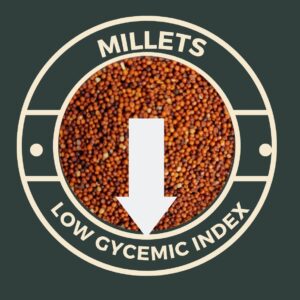
    The low glycemic index of millets favors controlling the blood sugar level in the body. In my previous blog, I have mentioned the millets which are good for diabetic patients.

    Related Post: 10 Health Benefits of Millets


    How much Millet to Eat Per Day:

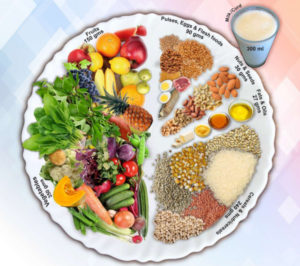
    Research has made things simple and easy for us. Blindly following a diet or taking a particular cereal every day may have side effects on our bodies. So taking the right kind of food and the right amount of food is very crucial. According to the ICMR-National Institute of Nutrition, Hyderabad, one should consume about 270 gm of Cereals including Nutri-Cereals(Millets). So, if you are taking millets then you can take about 1/3 rd(90-100gm of millets per day) of the recommended quantity.

    Can we eat millets daily
    My Plate for the Day, Source: ICMR-NIN, Hyderabad

    We should not take only millets rather mix prescribed amounts of different types of vegetables, pulses, fruits, nuts, seeds, milk/curd, fats, and oils.

    ICRISAT, Hyderabad conducted a scientific study on introducing Millets into a school feeding program and the outcome of the study was phenomenal. To improve the quality of the protein Millets were mixed with legumes. The proportion of essential amino acids in millets and legumes complement each other. So, combinations provide a higher quality of complete protein.

    When you cook millets, try to add legumes(Pulses) in the ratio of 3:1(Millets: Pulses).

    Click to Buy Best Millets Online

    How to eat Millets and include them in our diet:

    Always start with one or two millets and gradually include other millets. You can have one millet for two days and then change to another one. Every millet has its uniqueness in terms of nutrition, minerals, proteins, and micronutrients. Previously I have written a blog on “How to cook Millets Perfectly”, you can go through it, and definitely it will help in understanding millets better. Let me suggest some millet recipes which you can include in your breakfast, lunch, and dinner.

    1. Foxtail Millet Upma Recipe
    2. Ragi Dosa Recipe
    3. Millet Pulao Recipe
    4. Little Millet Idli

    I think by now you have got the answer to the question “Can we eat Millets Daily”? Make millets a part of your diet and definitely, you will feel the change in you and your family. I have witnessed the change in my family and hoping for the same from you.

    If you have any suggestions or advice please do comment below, I will be happy to hear from you.


    Author: Tapas Chandra Roy, Certified Farm Advisor on Millets –Promoting Millets from Farm to Plate


  • 10 Health Benefits of Millets will make you fall in love with it

    10 Health Benefits of Millets will make you fall in love with it

    Health Benefits of Millets:

    In this busy world, we sometimes forget the good things, which matters a lot for our life and healthy living. We do not care unless until we do not need it again. The same thing happened with millets. It was the time in India when millets were part of people’s diet during the 1960s. Millets came into my life 6 years back and became a part of my family.
    Let’s listen to what Millets says, “It’s time to rethink and bring our lost traditional millets and rediscover my values, benefits and make me a part of your daily life”. We have fallen in love with it because it has changed many things in our life.

    I am Tapas Chandra Roy, a Certified Farm Advisor on Millets, promoting millets from farm to plate. In this blog, I will be presenting the 10 Health Benefits of Millets. I am sure after knowing the health benefits of millets and their value, you will definitely include them in your diet.

    If you are new to millets and want to know about the different types of millets grown in India and how does it look it. CLICK HERE

    Health Benefits of Millets:

    1. All millets are gluten-free and recommended for celiac patients.

    Celiac disease is a digestive disorder that damages the small intestine, triggered by eating food containing gluten. Gluten is a protein found in wheat, rice, and many more grains. Gluten makes the dough elastic.
    When someone with celiac disease eats gluten food, their body overreacts to the protein and damages the villi of the small intestine.
    Celiac disease is found in 1 out of 100 people worldwide. So, millets are becoming a part of the diet of celiac patients.

    2. Due to a low glycemic index, Millets control diabetes.

    Health Benefits of Millets

    Many of us might be heard from our forefathers that, they had no diabetes during their time. But now, it is increasing at a fast rate in India and abroad. Now you could rightly point out what is going wrong now. It is all about the diet we consume, the lifestyles we are following with no exercise. It must be coming to mind, why we should consider millets.

    Millets have a low glycemic index, that means it raises the blood sugar slowly in the body instead of rising quickly as in case of rice.
    Due to the presence of high fibre, it takes more time for digestion. Millets contain complex carbohydrates which digest slowly in the body.
    If you are diabetic, want to add millets to your diet, then this article is for you from where you can make a choice, 5 miracle millets for Diabetes.

    3. Health Benefits of Millets -Millets help in decreasing obesity/weight loss.
    Due to less fibre in our diet, there is an increase in obesity in India mostly in urban areas. We are preferring more refined cereals based which contain less fibre. Dietary fibre helps in the retardation of carbohydrates absorption and impaired glucose tolerance. It helps in increasing the transit time of food in the gut. Tryptophan is found in millet (Foxtail Millet), which helps in managing weight. The presence of policosanols (Sorghum) favours weight loss. To understand, why millets help in weight loss, then this video is for you.

    4. Millets help in reducing the risk of cardiovascular disease.

    Millets contain essential fats, just the right amount to give our body natural fat. This helps prevent fat from depositing over muscles and
    avoid high cholesterol, heart strokes and heart-related diseases.

    5. Health Benefits of Millets in preventing Cancer.

    Millets are effective in the prevention of cancer initiation and progression. Millets contain fibres and phytonutrients, the combination of which is believed to reduce the risk of developing colon cancer.

    6. Millets helps to slow the ageing in our body.

    Everyone likes to look and remain young always. Millets are a good source of antioxidants. The high amount of anti-oxidants present in millets fights with the free radicals present in the body which slows down the ageing process.

    Health Benefits of Millets

    7. Millets help in better sleep.

    Are you worried about getting better sleep? Tryptophan in millets raises the serotonin level in the body, which helps in reducing stress.

    8. Millets help in reducing Hypertension.

    Millets help in preventing oxidation of low-density lipoprotein thus reducing hypertension.

    9. Health Benefits of Millets in preventing Anaemia.

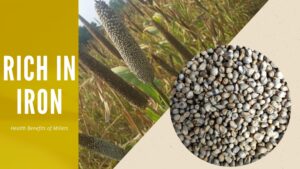
    In India, Anaemia is prevalent and it is mostly found in children, pregnant and non-pregnant women. Millets are the best source of iron. Iron is beneficial in preventing anaemia. Pearl Millet (Bajra) contains the highest iron content (11 mg per 100gm grains). Consumption of Pearl Millet prevents iron deficiency in the body.

    Health Benefits of Millets

    10. Millets improves skin elasticity.

    Millets are rich in amino acids called L-Lysine and P-Proline. Millets help to create collagen in the body, a substance that gives structure to the skin and tissue. Thus eating millet fortifies the collagen level to improve skin elasticity and makes it less prone to wrinkles.

    Millets are good for adults as well as for babies and children. The recent first scientific study on millet-based meals in-school programs boosted growth in children by 50%. I too have given millet food to my daughter right after 6 months and still continuing it. The best millet is Ragi which you can add to your baby’s diet after 6 months of age. Why millets are good for babies?? Here is the Answer.

    Hope these 10 health benefits of millets have given you enough reasons to add millets to your diet and after it in your regular diet, you will definitely fall in love with it as it will keep you healthy always. To know more about millets and millet recipes, you can subscribe to my Youtube Channel.

    Please let me know in the comment box, how was the article and how you are planning to add millets to your diet. I will be happy to hear from you.

    Author: Tapas Chandra Roy, A Certified Farm Advisor on Millets, ‘Promoting Millets from Farm to Plate’. In a mission to take the forgotten grains- Millets to Millions. To remain updated on my blogs on millets you can join my Telegram Channel – Millet Advisor.

  • Best way to know Millets in Hindi

    Best way to know Millets in Hindi

    Millets in Hindi:

    Millets are the ancient grains that were lost from our plate due to our more preference for Wheat and Rice. Now the demand for millets is increasing in India and also in the global market because it is full of nutrients and can build our immunity.

    In this blog, we will look deep into the millets type and what we call millets in the local language. So that we can identify the right millets and can include them in our regular diet.

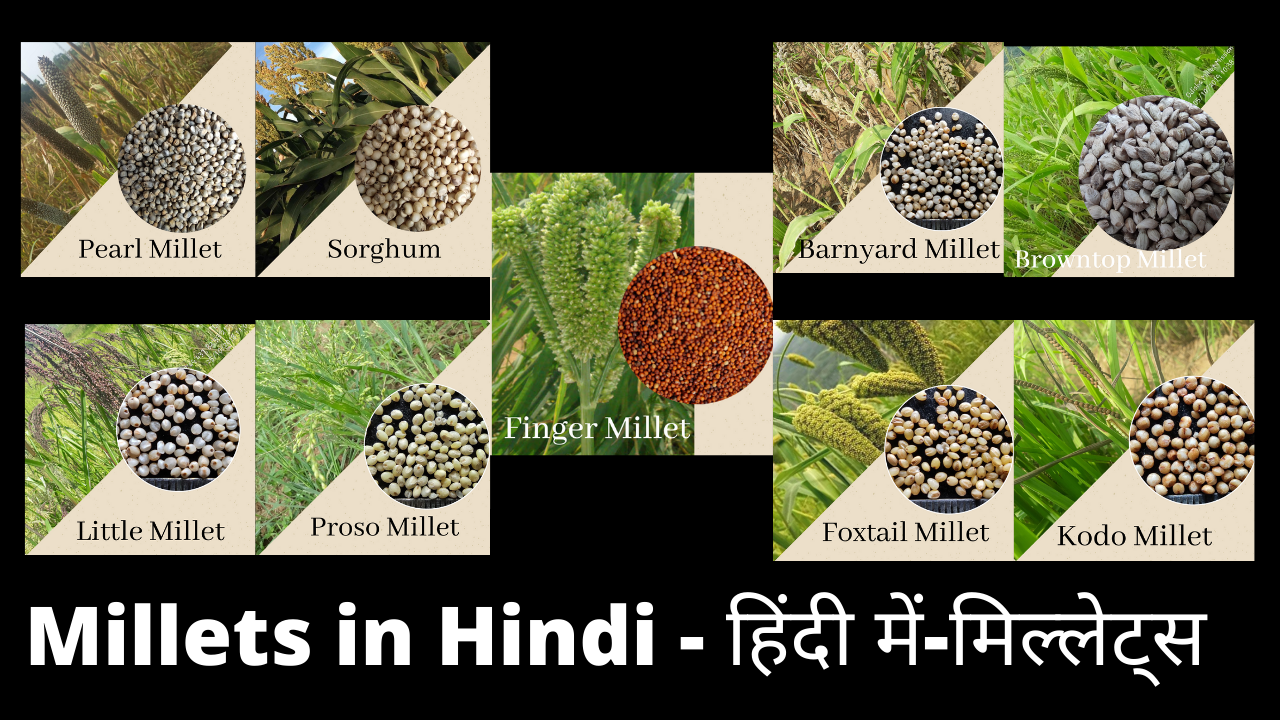
    Now let see the picture of millets one by one.

    Types of Millets:

    Millets in Hindi

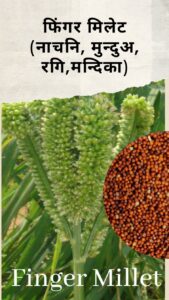
    Finger Millet is called Nachini or Mandua in Hindi. Most popularly known as Ragi. It is rich in Calcium and good for bones. We can also give to our babies after the completion of 6 months of age.

    Millets in Hindi

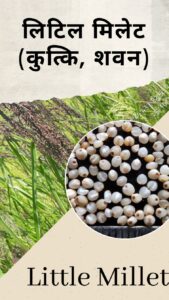
    Little Millet is called Kutki or Sawan in Hindi. It is good for people of all age groups. It prevents us from constipation and also helps in reducing fat from our body.

    Millets in Hindi

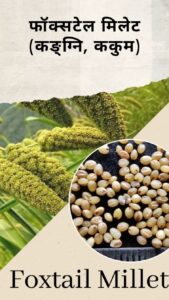
    Foxtail Millet is called Kagni in Hindi.

    Click to Buy Best Millets Online

    Millets in Hindi

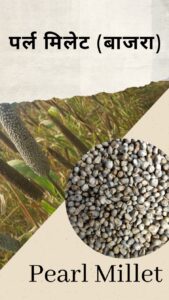
    Pearl Millet is called Bajra in Hindi.

    Millets in Hindi

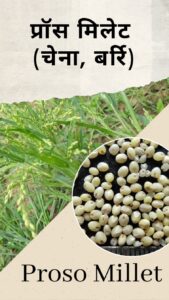
    Proso Millet is called Cheena in Hindi.

    Millet in Hindi

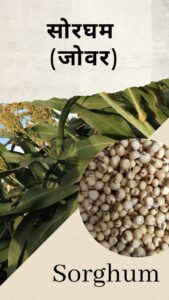
    Sorghum is called Jowar in Hindi.

    Millets in Hindi

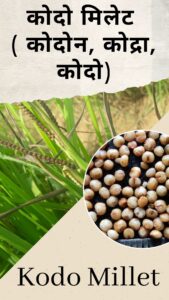
    Kodo Millet is called Kodon, Kodra, or Kodo in Hindi.

    Millets in Hindi

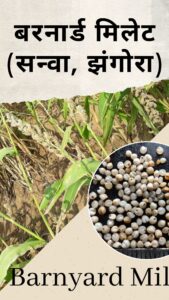
    Barnyard Millet is called Sanwa in Hindi. We generally consume Sanwa during ”Navratri”.

    Click to Buy Best Millets Online

    Millets in Hindi

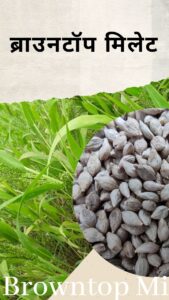
    Browntop Millet’s Hindi name is not yet confirmed. In Telegu, it is called Korale.

    I think by this time you could easily identify the millets. But for more understanding about it, I have provided a video below.

    Related Post: Identification of Millet Grains

    Click to Buy Best Millets Online

    Importance of Millets in Hindi:

    The Government of India has approved 2018 as the National Year of Millets and FAO has supported India’s proposal to celebrate 2013 as the International Year of Millets. Due to the rich content of nutrients in Millets, it is called Nutri-Cereals.

    In the coming days, Millets will be addressing the food, feed, fuel, malnutrition, health, and climate change issues.

    Let us listen to our honorable Prime Minister, India on the importance of Millets in Hindi.

    Related Post: Amazing Millets Health Benefits


  • Remembering Millets on Gandhi Jayanti 2020

    Remembering Millets on Gandhi Jayanti 2020

    Millets on Gandhi Jayanti:

    Gandhi Jayanti is celebrated to mark the birth anniversary of Mahatma Gandhi in India. On this day we pay a number of tributes. No doubt his philosophy has taught us many things in our life. But when I see the way we are moving towards our health and lifestyles, there needs more attention. The junk food and unhealthy diet we are taking are leading us to more nutritional disorders and lifestyle diseases like diabetes, hypertension, cancer, and many more.

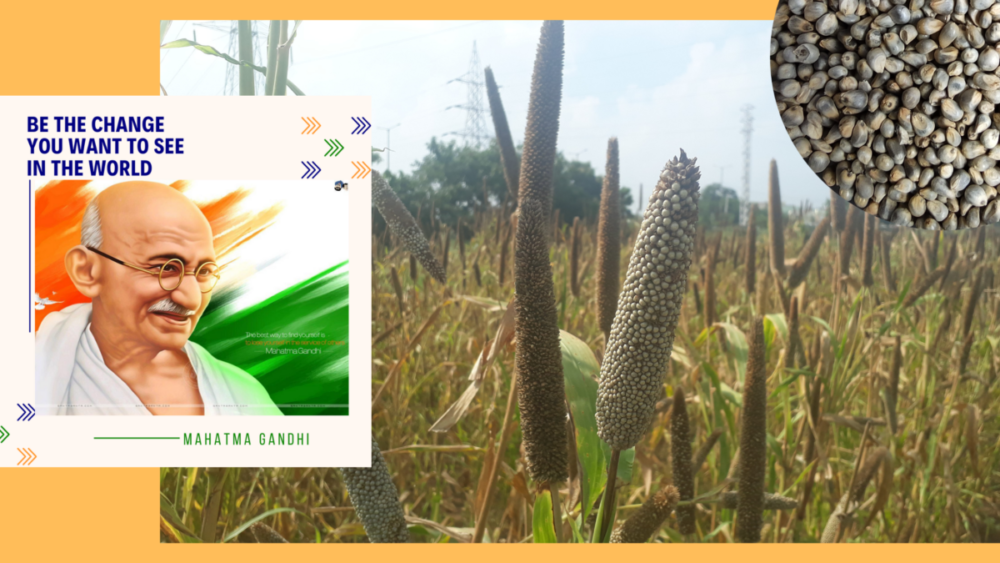
    Mahatma Gandhi was very much familiar with millets and done a lot of experiments with these crops and grains. He has mentioned about millets in his book named ”Key to Health”. Millets are good for our health as it contains a lot of nutrients which are very much helpful.

    Millets in Ayurveda:

    Millets are considered as healthy grains in both Ayurvedic and Western medicine. In Ayurveda, millets are considered Sweet, Heating, Dry, and Light because they are satisfying, nourishing, light, and easy to digest.

    We have forgotten the ancient traditional grains which are forefathers were taking. Its time to bring back to our plate. You must be thinking why millets. There are ample reasons which you can’t deny after knowing about it. Let us start with one by one.

    Why Millets?

    • Finger Millet contains the highest calcium 344mg per 100 gms. It helps in preventing malnutrition and ideal for diabetics as it has the ability to control blood glucose levels and hyperglycemia.
    • All Millets are gluten-free and are recommended for celiac patients.
    • They are rich in dietary fiber and it helps in decreasing obesity.
    • Millets are low glycemic index food and thus controls diabetes.
    • They are a rich source of iron and it helps in preventing anemia.
    • It helps in reducing the risk of cardiovascular diseases.
    • Millets are effective in the prevention of cancer initiation and progression.
    • It prevents oxidation of low-density lipoprotein and thus helps in reducing hypertension.

    Related Post: Types of Millets and their Health Benefits

    During the 1960s processing of millets was difficult and a lot of drudgeries were involved in it. During my field visit in the tribal areas of Koraput, Odisha witnessed to see the traditional processing of little millet and documented it for you.

    After watching this video, you must have known the difficulty in processing millets. But we must be thankful for the advancement of technologies in processing where the number of machines has been made by the manufacturers in India and made our work easier. We are now getting the cleaned and quality processed products of millets from the market.

    How we can add Millets in our Diet:

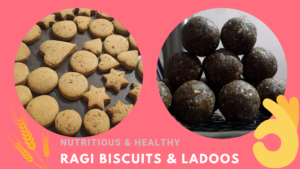
    As per my experience, I will suggest a few ways for you to include millets in your diet. If you are new to millets, start with one or two millets, and subsequently add others. You can make roti with these millets. Gradually, you can try your hands with breakfast recipes like Upma, Idli, and Dosa. Millets are good for children and much research work has been done on it and found to be effective in terms of health. You can make Ragi ladoos and biscuits for children and definitely they will love it.

    Ragi Ladoos and Biscuits
    Ragi Biscuits and Ladoos

    For more Millet Recipes: Watch my Youtube Channel

    Thumb Rules while Cooking Millets:

    • Soak it before cooking in water for at least 2 to 3 hours. But soaking millets overnight is more helpful.
    • To get the best taste of it, served it hot. If allowed to cool, they become drier than rice and wheat.
    • Always store it in a cool and dry place. Sun-drying at regular intervals will ensure more shelf life.

    Let us celebrate the day with Millets on Gandhi Jayanti by honoring Gandhiji’s philosophy. It will surely bring change in our health and improve the well being and we can lead a healthy life.

  • 5 Best Millets for Weight Loss

    5 Best Millets for Weight Loss

    5 Best Millets for Weight Loss:

    People are nowadays are very health conscious and finding food which is healthy around the globe. The best food which comes to my mind is the Millets. Due to the modern lifestyle, health-related problems like diabetes, obesity, cardiovascular disease, Millet is the best gift for human beings as they were the oldest foods that our forefathers were consuming. But due to the large-scale cultivation of wheat and rice has shifted our food habits.

    Millets have many nutritional, nutraceutical, and health-promoting properties which will keep our body healthy, and the important aspects which I am going to say today is about the properties which will help in weight loss and the best millets for weight loss.

    The unhealthy consumption of junk food has made people fatigue and in the long run, will affect our body and invite a lot of diseases. So the answer to all is the Millets.

    Table of Contents:

    1. Millets and types of Millets
    2. Nutritional Value of Millets
    3. Specific Content in Millets for Weight Loss
    4. Millet Recipes to start with
    5. Where to buy Millets

    Millets and types of Millets:

    Millets are the small-seeded grains that belong to the Poaceae family. They can be grown under marginal and low fertile soil with fewer inputs like fertilizers and pesticides. Now it is popularly known as Nutri-Cereals.


    Based on the grain size, the millets are categorized into Major and Minor Millets. Under major, there are two kinds of millets, which include Sorghum (Jowar) and Pearl millet(Bajra). The Foxtail Millet(Kangni), Finger Millet (Ragi/Mandua), Little Millet(Kutki), Kodo Millet(Koden), Barnyard Millet(Sawan), Proso Millet(Cheena), and Browntop Millet(Korale).

    Related Post: Types of Millets and its health Benefits

    Based on the presence of husk on Millets it is categorized into two types- Naked grains and Husked grains. Naked grains (Finger Millet, Sorghum, and Pearl Millet) do not have hard indigestible husk as other millets. It does not require much processing as compared to the husked grains, whereas the Husked grains(Little Millet, Foxtail Millet, Barnyard Millet, Proso Millet, Browntop Millet, and Kodo Millet) requires proper processing for human consumption.

    Click to Buy Best Millets Online

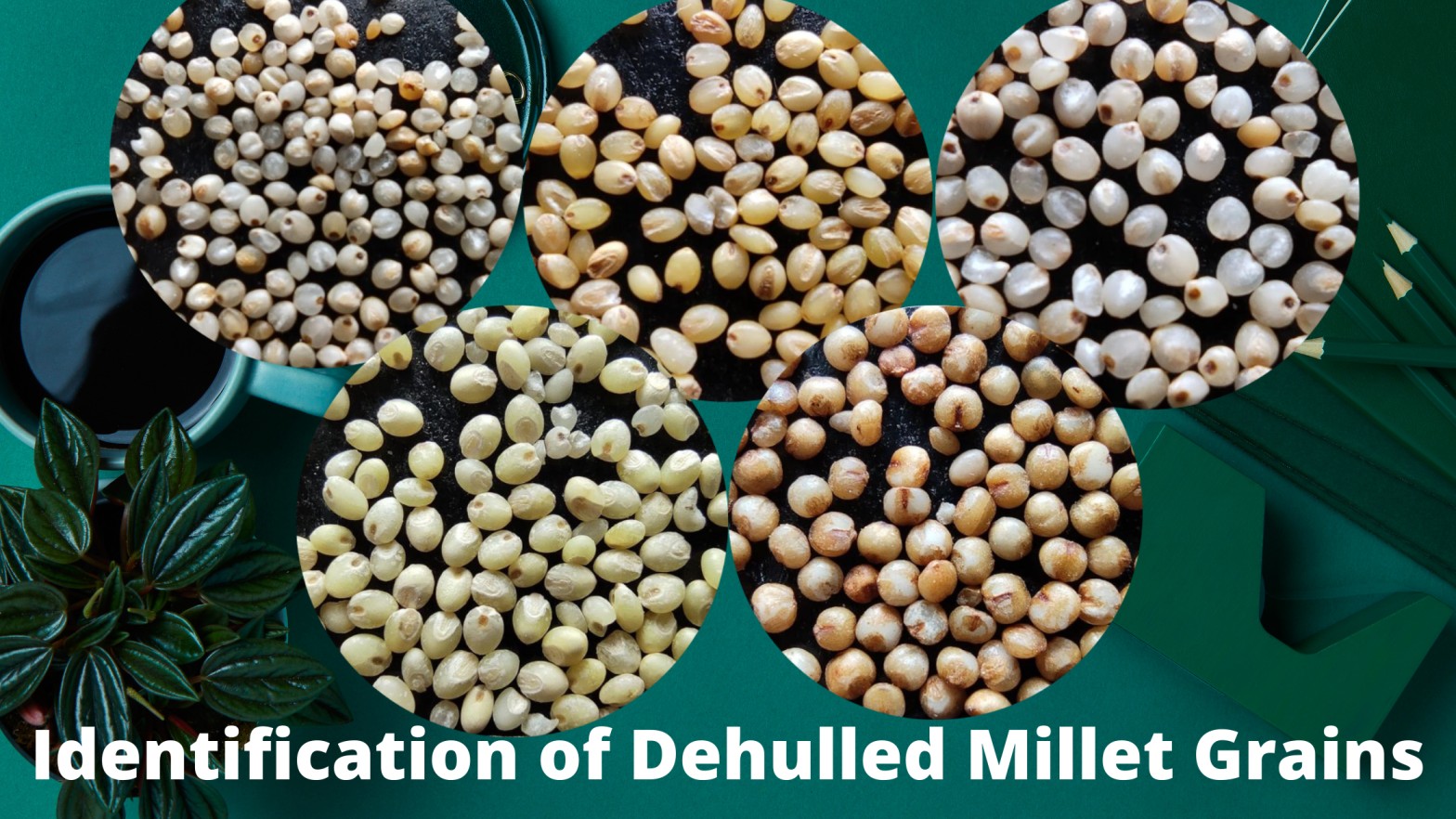
    Identification of Dehulled Millet Grains: Best Millets for Weight loss

    Identification of Dehulled Millet Grains


    Nutritional Value of Millets: Best Millets for Weight Loss

    Millets contain unique nutritional value especially complex carbohydrates, phenolic compounds, phytochemicals, and important dietary fiber. They are the natural source of Calcium, Iron, Zinc, Phosphorous, Potassium, and many other essential nutrients. The Calcium content in Ragi is 344 mg per 100 gram, which is the highest among the cereals.

    Health Benefits of Millets

    Click to Buy Best Millets Online

    Specific Content in Best Millets for Weight Loss:

    I think you must be familiar with the types of millet and the nutritional value of millets. So let us jump in to know the content of millets that are favoring weight loss in our body.

    Calorie Content of Millets: Best Millets for Weight Loss

    The calorie count of food is important with respect to weight loss or weight gain. From Research, it is found out that if we consume fewer calories than our body actually burns, may help us for losing weight faster. Barnyard Millet contains 307 kcal which you can include in your diet.

    Dietary Fibre Content- Best Millets for Weight Loss:

    As you know, the millets contain a lot of dietary fiber which helps to prevent constipation and reduce the risk of developing bowel disorders. But let’s see what are the function of dietary fiber in millets.

    • Retardation of carbohydrate absorption and impaired glucose tolerance.
    • In increasing the transit time of food in the gut.
    • In water-absorbing.
    • It helps in the binding of toxins as a detoxifying agent.

    The above function of dietary fiber in millets directly helps in the weight loss of the body. So, it must be coming to mind which millet to choose. Looking into the dietary fiber, there are five millets that are rich in it, Sorghum(10.2 g), Pearl Millet (11.5 g), and Finger Millet(11.2g) (Source: Indian Food Composition Tables, NIN-2017), and Barnyard Millet (12.6 g).

    Policosanols:

    Research has found out that the intake of policosanols helps in weight loss. Sorghum(Jowar) contains policosanols which help in reducing cholesterol in our body.

    Tryptophan: It is an alpha-amino acid that is used in the biosynthesis of proteins. The presence of tryptophan in Foxtail Millet(Kangni) gets digested at a slower rate and keeps us away from consuming extra calories in diet and favors in the weight loss journey.

    Click to Buy Best Millets Online

    So, the 5 Best Millets that will help us in Weight Loss are as follows:

    1. Sorghum
    2. Finger Millet
    3. Barnyard Millet
    4. Foxtail Millet
    5. Pearl Millet

    Best Millets Recipes to Start with the Journey of Weight Loss: Best Millets for Weight Loss

    1. Jowar, Bajra, and Ragi Roti
    2. Millet Upma: You can include Foxtail Millet and Barnyard Upma in your breakfast which is easy and quick to prepare. I have made many millet recipes that you can check in my blog as well as on my Youtube Channel.

    Foxtail Millet Upma Recipe

    Barnyard Millet Upma:

    Barnyard Millet Upma Recipe

    Where to buy Best Millets for Weight Loss:

    It is always recommended to buy millets directly from the farmers. If you are staying in urban areas then you can easily buy from an online store.

    CLICK TO BUY THE BEST MILLETS FOR WEIGHT LOSS:

    1. Organic Ragi Flour

    2. Organic Sorghum Flour

    3. Organic Bajra Flour

    4. Foxtail Millet

    5. Barnyard Millet

    Why Overweight/Obesity is Increasing?

    Due to lack of dietary diversity, there is an increase of non-communicable diseases, Overweight/Obesity is one of them. We need to understand, why obesity is increasing at a rapid rate in India.

    1. When we look into the ingredients that we use to make our food,  we prefer a more refined cereal-based diet and this food contains no dietary diversity.
    2. We intake more high-calorie diet with low nutrients which is unhealthy.
    3. The consumption of packaged food is increasing which is rich in high sugar, salt, and fats.

    In a nutshell, this video on Best Millets for Weight Loss is the main summary of what we have discussed above. I think you will love it.


    Hope you liked reading this article and it will help in your weight loss journey. Please do give your comments below for further improvement.

    Author: Tapas Chandra Roy, A Certified Farm Advisor on Millets. Promoting Millets from Farm to Plate.


  • The revival of Millet Grain on Farm to Plates addressing Nutritional Security

    The revival of Millet Grain on Farm to Plates addressing Nutritional Security

     Odisha Millets Mission in Sundargarh:

    “Special Programme for Promotion of Millets in Tribal Areas of Odisha” (Odisha Millets Mission)- Reviving Millets on Farm to Plates. It is a flagship programme supported by the Department of Agriculture & Food Production, (Govt of Odisha) to promote millets. It was launched in Sundargarh district in the year 2018-19. The programme initially covered 4 blocks, that is, Nuagaon, Kuarmunda, Rajgangpur and Kutra, which was gradually extended to another 4 blocks (Lephripada, Hemgir, Tangarpali & Balisankara) with financial assistance from District Mineral Foundation, Sundargarh.

    The programme covers all aspects of millet ecosystem that includes production, consumption, processing, marketing and inclusion of millets in State Nutrition Programmes.
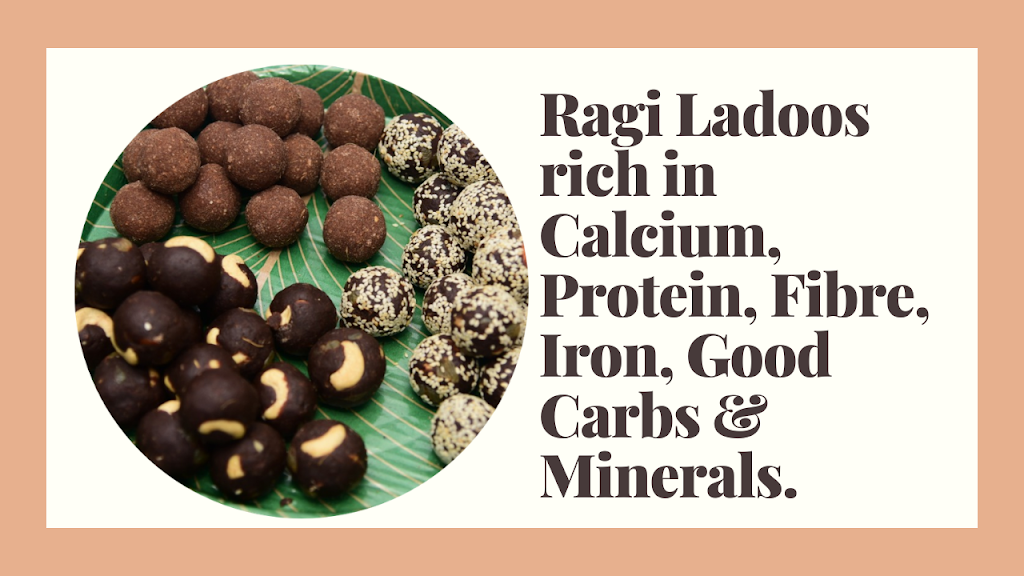
    Ragi Ladoos for Nutritional Security
    Ragi Ladoos for Pre-School Children


    The objectives of the Millet Mission:
    1. Improving the productivity of Millet crops to secure household level surplus.
    2. Setting up of decentralized processing facilities for easy access to processed millets.
    3. Promoting Household-level consumption to increase food and nutrition security.
    4. Promoting farmer collectives and marketing to further the millet economy with a focus on women entrepreneurs.
    5. Inclusion of millets in the State Nutrition Programme and Public Distribution System.
    The success of Odisha Millets Mission owes to its unique design of programme delivery involving various stakeholders like Government agencies, Civil Society Organisations, Community Based Organisations and Academic institutions. In Sundargarh, 8 Community-Based Organisations have been implementing the programme with the support of 6 Facilitating NGOs.
    The Agricultural Technology Management Agency (ATMA), Sundargarh acts as the nodal organisation for implementation of the programme at the district level. The State Secretariat for Odisha Millets Mission is hosted at Nabakrushna Choudhury Centre for Development Studies (NCDS), a social science research institute situated at Bhubaneswar. The State Secretariat comprises of Programme Secretariat and Research Secretariat anchored by WASSAN and NCDS respectively.
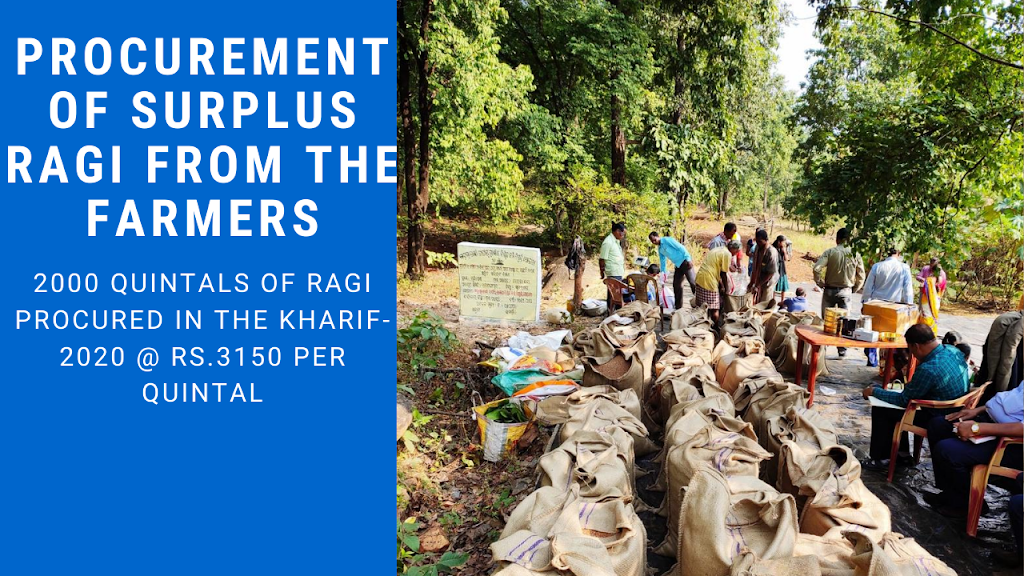
    In the first year of implementation (2018-19), millet (exclusively Ragi) was cultivated in 600 Hectares benefitting 1405 farmers in 4 blocks of the district. During 2019-20, 930 Hectares of millet was cultivated including Ragi, Little Millet, Foxtail Millet and Sorghum involving 2820 farmers. A surplus of around 500 quintals of Ragi was procured from farmers in the Kharif Marketing Season 2018-19 which increased 4 folds to just above 2000 quintals in Kharif Marketing Season 2019-20. 
    Procurement of Surplus Ragi from farmers
    Procurement of Surplus Ragi from the Farmers


    The millets, owing to its nutritional benefits, climate resilience characteristics and nostalgic sentiments about the grain being attached with their tribal culture have added to the other incentives provided by the programme to encourage farmers to cultivate and consume millets. The positive feedbacks from the agrarian community and successful implementation of the programme paved the way for an expansion of the scheme to 4 additional blocks with support from District Mineral Foundation, Sundargarh from 2020-21.
    Inclusion of Ragi Ladoo in ICDS, Sundargarh
    Background of Millet Mission:
    In a series of discussions at State level regarding utilization of the Ragi procured from farmers it was proposed that Ragi, for its nutritional values should be included in the ICDS using DMF and OMBADC funds, based on which the pilot programme for introducing Ragi Ladoo for pre-school children in Anganwadis Centres of Sundargah the district was planned.
    Ragi is extremely nutritious millet rich in Calcium(344 mg), Protein(7.3 gm), Fibre(3.6 gm), Iron(3.9 mg), Good carbohydrate(72 gms), and other essential minerals. In the process of hulling, the nutrition content of ragi is not lost. Hence, this is an excellent grain for the children.
    About the Project:
    The project envisages supplementing the nutritional requirements of pre-school children (3 to 6 years) enrolled in the Anganwadi Centres of the district. Each child shall be provided with 4 Ragi Ladoos per week comprising of 10.5 gms of Ragi in each Ladoo.
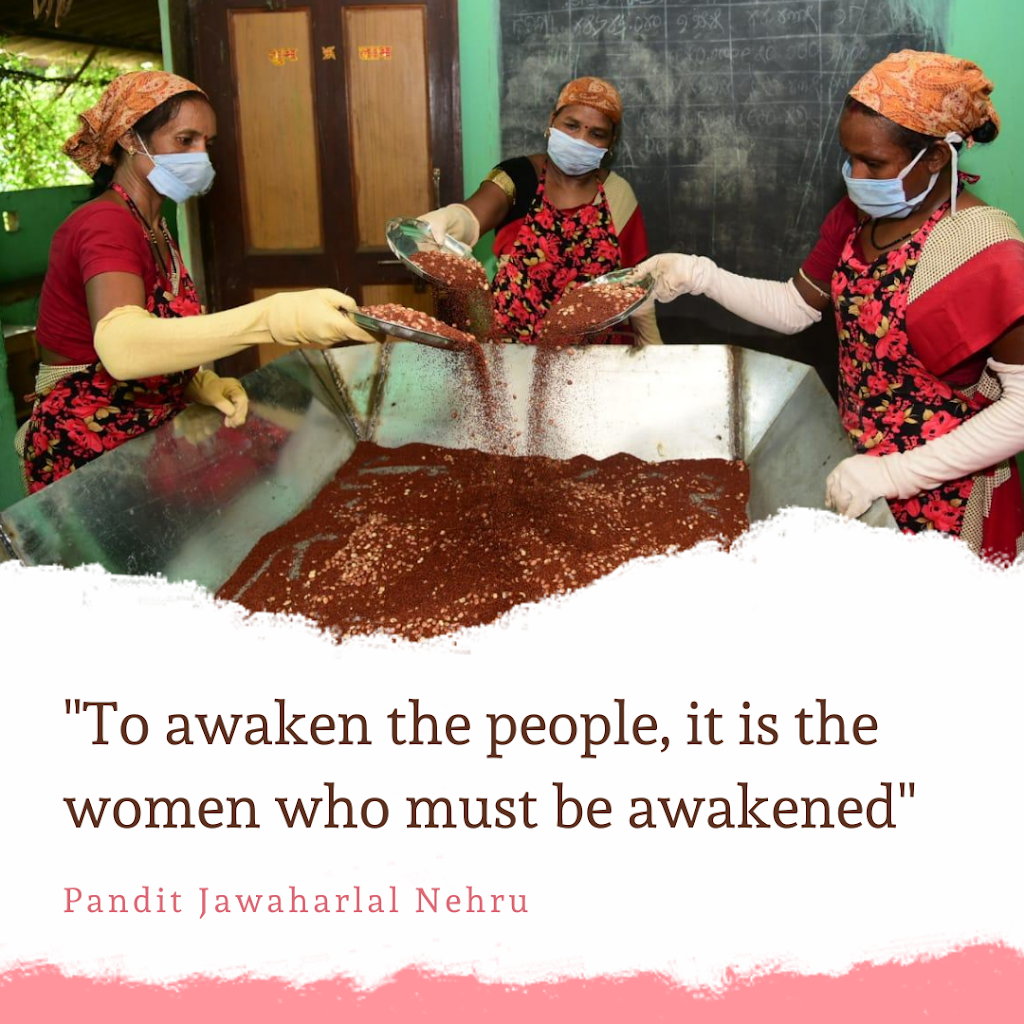
    The existing WSHGs engaged as the THR (Take Home Ration) making units or Chhatua Units in each ICDS project area, promoted by Mission Shakti (W&CD Dept, Govt of Odisha) shall be trained to prepare and supply the Ragi Ladoo Mix to the Anganwadi Centres.
    The Anganwadi helpers shall make ladoos out of the Ragi Ladoo Mix and provide to the children. As Anganwadi Centres are closed in the present pandemic situation, the Ragi Ladoo Mix is packaged and supplied to the beneficiaries’ home on a monthly basis.
    The project, supported by DMF, Sundargarh is a joint initiative involving 2 agencies, that is, Odisha Millets Mission (Directorate of Agriculture & Food Production, Odisha) & Mission Shakti / ICDS (Dept of Women & Child Development and Mission Shakti, Odisha).
    Odisha Millets Mission shall ensure enhancement in millet production in the district and thereby the availability of surplus Ragi in procurement Mandis. They shall also provide machinery required for cleaning, grading and destoning ragi grains to the selected WSHGs. Two WSHGs in the district have been empanelled as the cleaning units, which shall clean the ragi grains using the machinery and supply to the various Chhatua Units for preparation of Ragi Ladoo Mix. The project shall be implemented in a phased manner.
    Millet Ladoo making
    Preparation of the First batch of Ragi Ladoo Mix by Jyoti SHG of Bileimunda, Hemgir Block

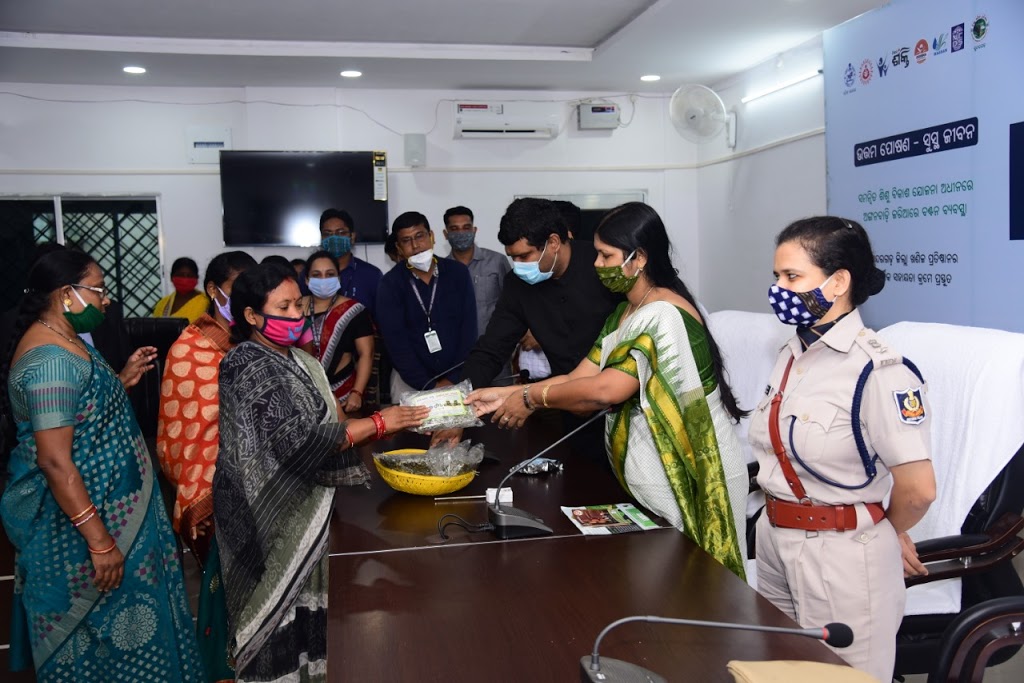
    The first phase was inaugurated by the Minister of WCD&Mission Shakti on 15th August 2020 in which about 3000 children of Hemgir project were covered. From November 2020, the second phase shall be launched in 5 project areas (primarily urban) and in the third phase, starting from January 2020 all 21 project areas are planned to be covered.

    Millet ladoo mix distribution
    Distribution of Ragi Ladoo mix by the Honourable Minister WCD & Mission Shakti to beneficiaries in the Inaugural Ceremony.


    This initiative was jointly undertaken by Odisha Millets Mission & Mission Shakti, with support from DMF, Sundargarh and Sundargarh District Administration has exemplified how convergence among different agencies have successfully revived the journey of a once-neglected the Nutri-cereal grain on-farm to plates and thus this initiative will address the Nutritional Security.
    Author: Arpan Das, District Project Coordinator, WASSAN, Odisha Millet Mission
  • Millets to boost strong immunity in 2020

    Millets to boost strong immunity in 2020

     MILLETS ARE THE RIGHT GRAINS:

    We have heard the old saying ”You are what you eat”. If you are taking the right balanced diet, you remain healthy always. But we have forgotten the old millet grains which our grandparents were taking in their food and this has given us more lifestyle diseases. So in this situation, we should focus on boosting our immunity and health. The right grains that we can add to our regular diet are the ”Millets” and boost our immunity.

    Why Millets?

    It contains a high amount of dietary fibre, essential amino and fatty acids, B-complex vitamins and Vitamin E. They are high in minerals, iron, magnesium, phosphorous and potassium. These minerals help us as a shield and protect us from infections and diseases. They contain more fibre which lowers the risk of diabetes by releasing a lesser percentage of glucose over a long period of time.

    So, making excuses for not including millets, will only keep us far away from better health. Millets can be taken by adults, children and Babies. The sooner you bring them in your regular diet, the faster you witness the positive changes in your health. It is the sole responsibility of parents to add millets so that children gradually accept these grains.

    Of course, there is a lot of things to learn about millets and understand the right way to cook it. You will definitely find wonderful recipes out of millets in my blogs as well as in my youtube channel. I am a Certified Farm Advisor on Millets and promoting Millets from ”Farm to Plate”. You can surely mail me or comment on this blog if any query comes to your mind.

    Millets to boost strong immunity
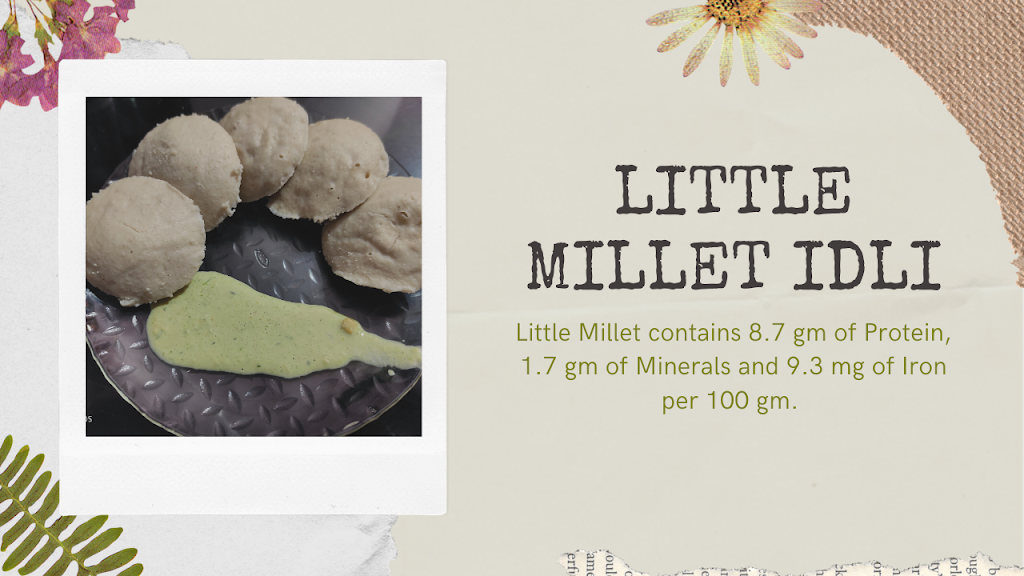
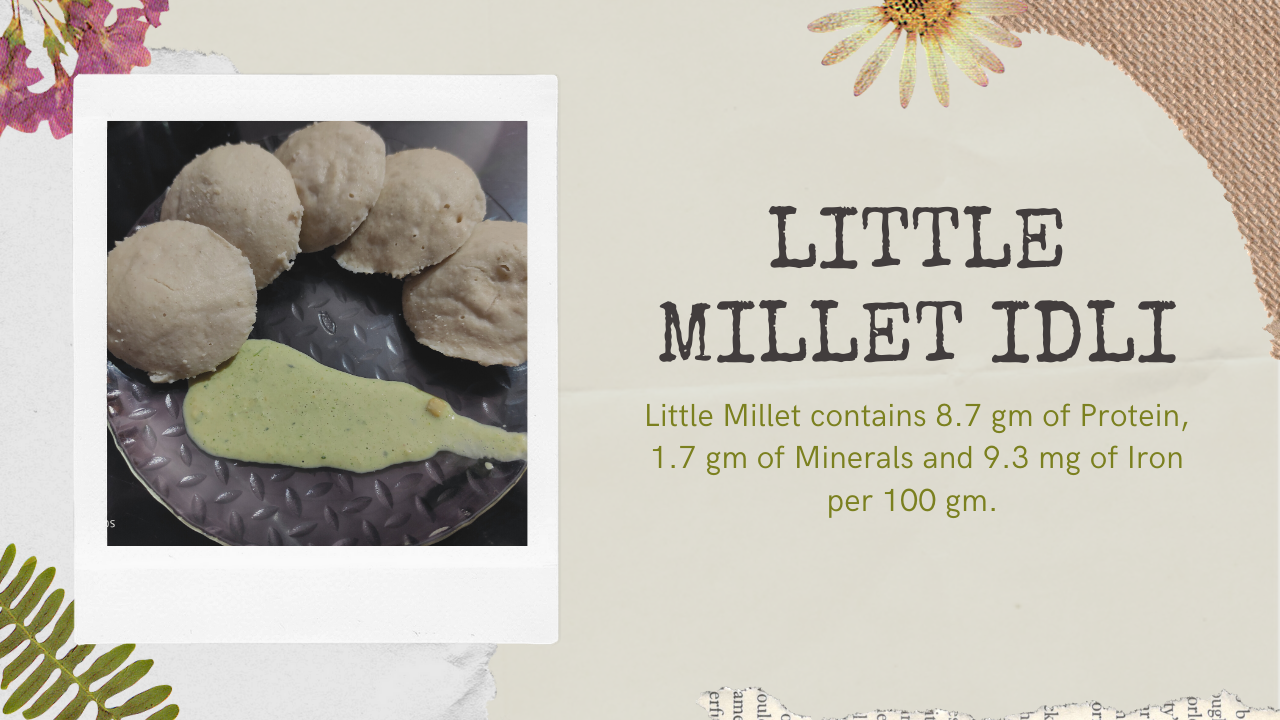
    Little Millet Idli

    On the day of ”Janmashtami”, First of all, Wish a very Happy Janmashtami. Yesterday evening I thought to share a new recipe of Idli with Little Millet. Generally, it is consumed as rice and any recipe that demands staple rice can be prepared using Little Millet. It looks similar to Proso Millet after dehulling, but you can easily differentiate by its prominent spot and the size. Little Millet is the smallest of all minor millets.

    Little Millet is reported to have 8.7 gm protein, 7.6 gm fibre, 9.3 mg iron, 1.7 gm minerals per 100 gm. It contains 13 times more iron than rice. We can make a lot of recipes using this Millet. I will keep you updating the wonderful recipes.

    So, let us see the ingredients and method to make Little Millet Idli.

    Ingredients:

    • 1 cup Little Millet
    • 1/2 cup Urad Dal
    • 1 tbsp Methi seeds
    • 1 cup Water
    • 1 tbsp Puha (flattened rice)
    • Salt as per taste
    Preparation Method:
    • Little Millet, Urad Dal and Methi seeds are taken separately and soaked for 3 hours.
    • Urad Dal is then ground in a wet grinder until it becomes a soft batter.
    • Water is drained out from Little Millet and ground along with the methi seeds and puha till nice batter.
    • All the batter is mixed together thoroughly and allowed to ferment overnight.
    • After that little salt as per taste is added to the batter and idlis are steamed in idli Steamer.
    • Idlis are cooked till they are soft texture and served hot with chutney.

    Thumb Rules while Cooking Millets:

    • Soak it before cooking in water for at least 2 to 3 hours. But soaking millets overnight is more helpful.
    • To get the best taste of it, served it hot. If allowed to cool, they become drier than rice and wheat.
    • Always store it in a cool and dry place. Sun-drying at regular interval will ensure more shelf life.

    CLICK TO BUY LITTLE MILLET

    Please text me in the comment box, how it turned out with you.

    (Tapas Chandra Roy, a Certified Farm Advisor on Millets and promoting Millets from ”Farm to Plate”).

  • Differentiate 5 Types of Dehulled Millets with Clarity

    Differentiate 5 Types of Dehulled Millets with Clarity

    Millets:

    In the beginning, it was difficult for me to identify millet grains after dehulling. But gradually, going deep into its size, shape, and colour, it became easy for me. So, today I thought to share with you about these dehulled millets and how to differentiate dehulled millet. If you want to know about the details of unhulled millet grains, you can have a look at the previous blog on the Close-Up of Millets

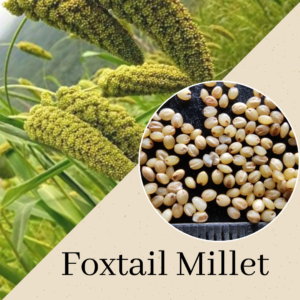
    1. Foxtail Millet:

    Millets-Foxtail Millet
    Foxtail Millet Panicle and Dehulled Grains

    It resembles a tail of a fox, so it is called a Foxtail Millet. It is one of the oldest cultivated millets. It is the most yellowish colour millet with slightly oblong on one end.

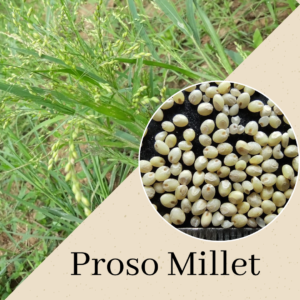
    2.Proso Millet:

    Millets-Proso Millet

    Proso Millet is called ”Chena” in Hindi and ”Variga” in Telegu. It is the largest grain in the category of minor millets. It is creamy yellowish and perfect oblong on one end.

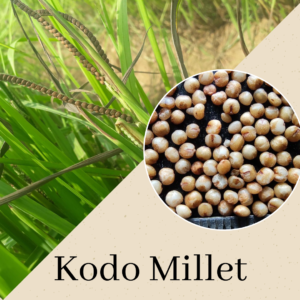
    3.Kodo Millet:

    Kodo Millet
    Kodo Millet and its Dehulled Grains

    Kodo Millet is called ”Kodon” in Hindi and ”Arikelu” in Telugu. It is brownish in colour and the colour gets lighter after polishing.

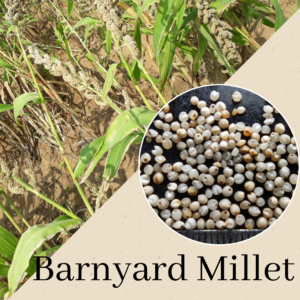
    4.Barnyard Millet:

    Barnyard Millet
    Barnyard Millet Panicles and its Grains

    Barnyard Millet is known as ”Sanwa” in Hindi and ”Udhalu” in Telegu. It is similar to Little Millet but the colour is little greyish as compared to Little Millet. The easy way to differentiate it, by its prominent dark spot.

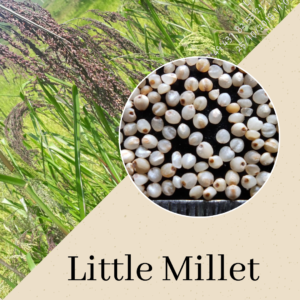
    5.Little Millet:

    Little Millet
    Little Millet and its Dehulled Grains

    Little Millet is called ”Kutki” in Hindi and ”Samalu” in Telegu. It is the whitish millet in the Minor Millet category. It is spherical in shape. Little millet is the smallest millet.

    For More Videos on Millets: Subscribe to my Youtube Channel

    Author: Tapas Chandra Roy, A Certified Farm Advisor on Millets, ‘Promoting Millets from Farm to Plate’. In a mission to take the forgotten grains- Millets to Millions. To remain updated on my blogs on millets you can join my Telegram Channel – Millet Advisor.

  • Millet Grain Anatomy

    MILLET GRAIN ANATOMY

    There  are three main parts in the millet grain:
    1.Bran
    2.Germ
    3.Endosperm

    Bran:

    It contains important minerals, vitamins, fiber, and antioxidants. It protects the kernel from pests, diseases, water, and sunlight. It is the multi-layered outer skin of the kernel.
    So, while processing millets utmost care should be taken to keep the bran layer intact. Completely removing the bran will result in the deterioration of nutrients.

    Germ:

    It contains vitamins, antioxidants, phytonutrients, and unsaturated fats. It will sprout into a new plant when fertilized by the pollen.

    Endosperm:

    It provides food and energy to the new plant when it is young. It contains starchy carbohydrates, vitamins, minerals, and proteins.